Závěrečná práce: Bc. Matěj Hamala: Efficient Implementation of Dynamic Time Warping for Motion Data
Diplomová práce
Efficient Implementation of Dynamic Time Warping for Motion Data
Anotace
S rostoucí dostupností technologií pro zachycení pohybu (MoCap) se značně zvýšila potřeba efektivního zpracovávání velkého množství MoCap dat. Jedna z klíčových výzev zpracování těchto dat spočívá ve vyhledávání založeném na podobnosti, které se obvykle realizuje pomocí algoritmu Dynamic Time Warping (DTW). Kvadratická složitost DTW však komplikuje jeho širší použití. Díky poslednímu výzkumu bylo představeno …více
Abstract
As motion capture technologies become more prevalent, the need for effective management of extensive motion data has grown significantly. One primary challenge is similarity-based searching within motion capture data, typically approached with the Dynamic Time Warping (DTW) algorithm. However, the quadratic complexity of DTW complicates its large-scale application. This issue has been widely researched …více
Zadání práce
Dynamic Time Warping (DTW) is an algorithm for measuring similarity between two temporal sequences that may vary in speed. For instance, similarities in walking could be detected using DTW, even if one person was walking faster than the other. The DTW is used in many application domains, including human motion analysis, speech recognition, or financial data analysis.
The DTW algorithm is based on dynamic programming and its computation is quadratic to the length of its input, which is in many cases quite prohibitive. In 2012, a very interesting paper called “Searching and Mining Trillions of Time Series Subsequences under Dynamic Time Warping” was published, introducing a number of possible optimizations of the DTW. The paper demonstrated impressive improvement of the DTW efficiency. However, the presented techniques were only used on one-dimensional data and rather basic use-cases.
In the DISA laboratory, we are using the DTW for analyzing motion data, which in their raw format are long high-dimensional time series. We are also able to transform the motions into more compact temporal sequences but with some specific properties. For both these types of time series, it would be extremely useful to have a more efficient implementation of DTW than the basic one we have now. Therefore, the objective of the diploma thesis is to study the techniques presented in the above-mentioned paper and other related ones, and analyze their suitability for our data. The selected techniques will be implemented within the MESSIF library for similarity searching and experimentally evaluated on motion data.
23. 5. 2023 15:00, RNDr. Petra Budíková, Ph.D., učo 66445
 angličtina
Konzultant
Práce na příbuzné téma
Seznam prací, které mají shodná klíčová slova.
-
Similarity-based Matching of Fast and Slow Motions using Motion Words
Mgr. Matěj Bagar -
Advancing Motion Words for Human Motion Classification
RNDr. David Procházka, učo 485104 -
Similarity Search in Stream Processing
RNDr. Filip Nálepa, Ph.D. -
Využití shlukovacích algoritmů pro kvantizaci pohybových dat
Bc. Tomáš Martinčík -
Compact and Interpretable Representations for Similarity Modeling of High-Dimensional Data
RNDr. Miriama Jánošová, Ph.D., učo 424615 -
Experimental Verification of a Synergy of Techniques for Efficient Similarity Search in Metric Spaces
Bc. Iuliia Mariachkina -
Prostorové sledování množiny bodů pomocí kalibrovaných kamer
Mgr. Miroslav Krajíček -
Information Retrieval Techniques for 3D Human Motion Data
Mgr. Ján Horváth
Složky
Soubory
-
Přidání souboru
 Soubor nebo složku lze nahrát pomocí tlačítka Přidat.
 -
Další operace se soubory
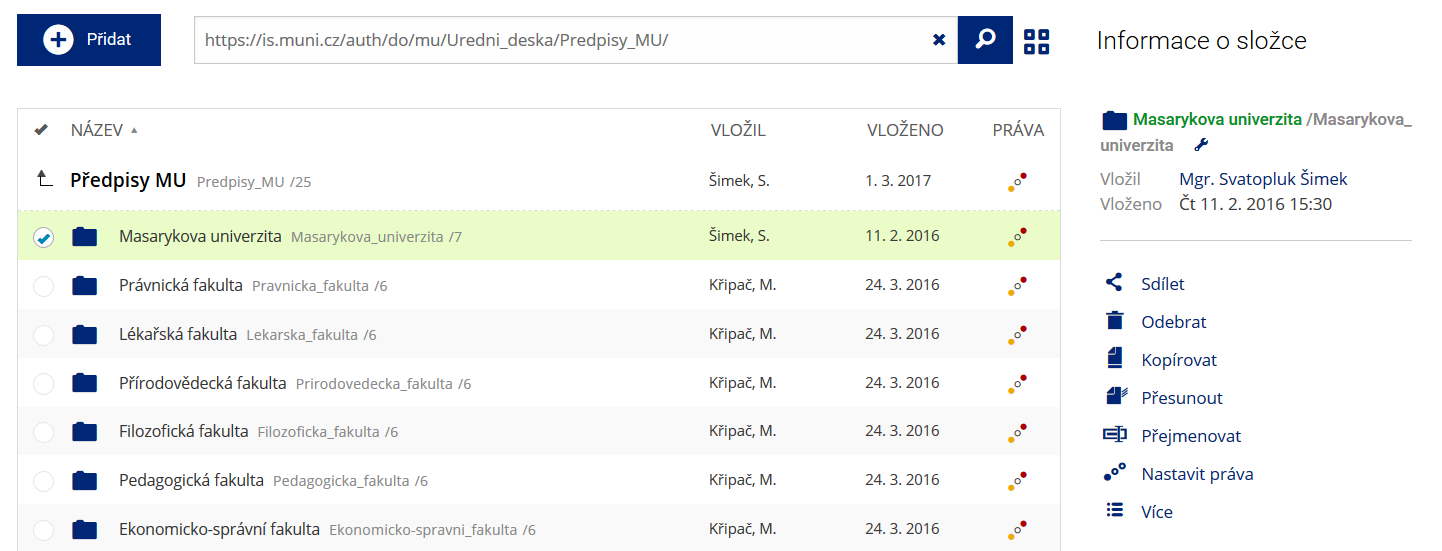 Podrobnosti lze zjistit označením příslušného řádku.
 -
Pohled pro experty
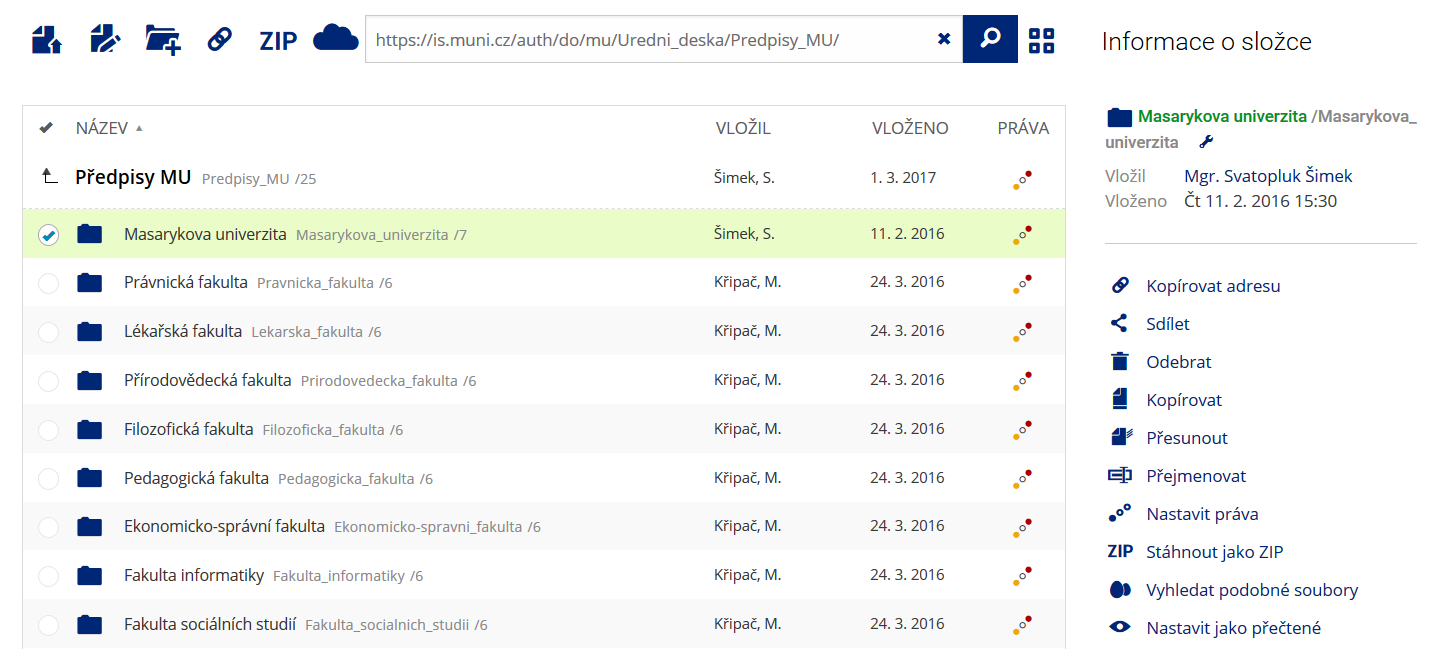 Pro častou práci je možné zvolit režim Více možností.
 -
Vyhledávání souborů
 Vyhledávaný výraz můžete zadat přímo do adresního řádku.
 -
Rychlý přístup k souborům
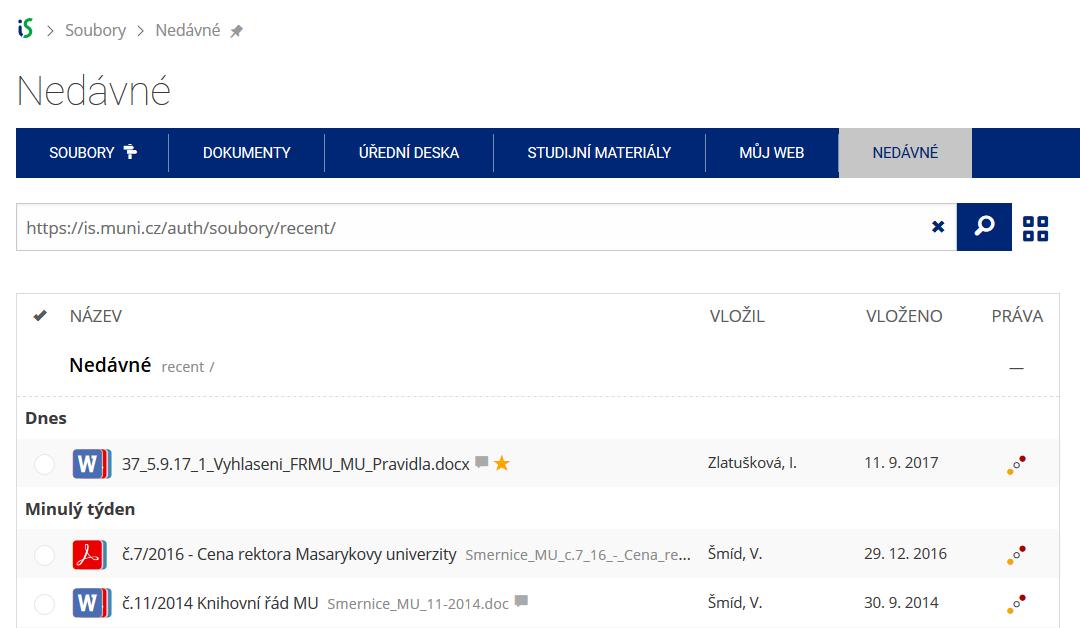 Pomocí funkce Nedávné je možné se rychle vrátit k právě prohlíženým souborům. Oblíbené soubory je také možné označit Hvězdičkou.